
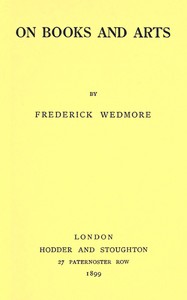
On books and arts by Sir Frederick Wedmore
Sir Frederick Wedmore's On Books and Arts isn't a novel with a traditional plot. Instead, think of it as a guided tour through the mind of a late-Victorian connoisseur. The book is a compilation of his critical essays, originally published in periodicals. Each piece focuses on a different subject—sometimes a single author like Robert Louis Stevenson, sometimes a group of French etchers, other times a broader theme in literature.
The Story
There's no narrative arc in the usual sense. The 'story' is the journey of Wedmore's observations. He moves from analyzing the precise skill in an artist's line work to praising the emotional depth in a novelist's characters. He writes about what he sees in galleries and what he feels when reading. The structure is conversational; one essay flows into the next based on his curiosity and expertise. It’s less about building an argument and more about sharing a lifetime of refined appreciation.
Why You Should Read It
I loved this book for its voice. Wedmore isn't a dry academic. He’s enthusiastic and opinionated in the best way. You can feel his genuine thrill when he describes a perfect passage of prose or a masterful etching. Reading it today is fascinating—it’s a direct window into what a cultured English gentleman in the 1880s and 1890s valued in art. Some of his references might be obscure now, but his core questions feel timeless: What makes beauty? How does technique serve feeling? His passion is contagious, and it made me look at my own bookshelf with fresh eyes.
Final Verdict
This is a niche but wonderful read. It’s perfect for history buffs who want to feel the texture of Victorian cultural life, or for avid readers and art lovers who enjoy the 'criticism' side of their hobbies. It’s not for someone seeking a fast-paced story. But if you like the idea of slowing down and spending time with a sharp, elegant mind from the past, Wedmore is a brilliant companion. Keep a phone handy to look up the artists he mentions—it turns the read into a delightful treasure hunt.
No rights are reserved for this publication. Use this text in your own projects freely.
David Jones
1 year agoI had low expectations initially, however the pacing is just right, keeping you engaged. Definitely a 5-star read.
Emma Hernandez
4 months agoAs someone who reads a lot, the clarity of the writing makes this accessible. Highly recommended.
Matthew Wright
3 months agoSimply put, the author's voice is distinct and makes complex topics easy to digest. A valuable addition to my collection.
Jennifer Anderson
1 year agoI didn't expect much, but it manages to explain difficult concepts in plain English. I couldn't put it down.
Betty Thompson
1 year agoBased on the summary, I decided to read it and the clarity of the writing makes this accessible. I will read more from this author.