
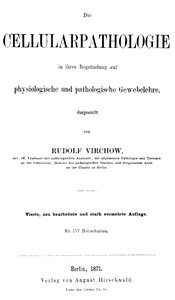
Die Cellularpathologie by Rudolf Virchow
Published in 1858, Rudolf Virchow's Die Cellularpathologie isn't a novel with a plot in the traditional sense. Its 'story' is the argument itself—a forceful, detailed case for a completely new way of seeing the human body and its diseases.
The Story
Before Virchow, many doctors thought illness was caused by imbalances in vague bodily fluids or by mysterious environmental poisons. Virchow, using the newly powerful microscopes of his time, made a bold claim: All disease is, at its root, disease of the cell. The book walks you through his evidence. He shows how healthy tissues are made of healthy cells, and how sick tissues are full of cells that have changed, multiplied out of control, or died. He applies this 'cellular theory' to explain everything from inflammation and tumors to how wounds heal. The central drama is Virchow's intellectual battle against the old, fuzzy ideas, replacing them with a clear, physical principle you could see under a lens.
Why You Should Read It
It's humbling and exciting. Humbling because you realize how recently we knew so little. Exciting because you witness a foundational 'aha!' moment in science. Virchow's writing is direct and confident; you can feel his passion. He wasn't just describing cells; he was building a new rulebook for medicine. When he writes 'Omnis cellula e cellula' ('Every cell stems from another cell'), it feels like a law being declared. Reading this connects the dots between a 19th-century lecture hall and your last doctor's visit. It makes you appreciate that the modern concepts of cancer pathology, biopsies, and targeted treatments all sprouted from the seed of thought planted here.
Final Verdict
This is not a light read, but it's a profoundly rewarding one. It's perfect for history and science enthusiasts who want to go beyond simplified stories and meet a pivotal idea at its source. If you enjoy books like The Emperor of All Maladies or are fascinated by how major scientific paradigms shift, you'll find Virchow's original argument thrilling. Think of it as the blueprint for the house of modern medicine. For the curious general reader willing to engage with a dense but world-changing text, it offers a front-row seat to a revolution that still shapes our health today.
This book is widely considered to be in the public domain. Knowledge should be free and accessible.
Noah Lee
1 year agoText is crisp, making it easy to focus.
Barbara Flores
1 year agoHelped me clear up some confusion on the topic.
Nancy Sanchez
6 months agoFast paced, good book.
Edward Thompson
1 year agoThe index links actually work, which is rare!


Brian Hill
7 months agoAmazing book.