
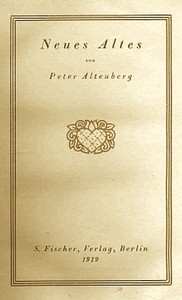
Neues Altes by Peter Altenberg
Peter Altenberg's 'Neues Altes' (which translates roughly to 'New Old Things') is a collection of what he called 'sketches.' Don't expect a traditional story. Instead, imagine walking through Vienna in 1910 with a brilliantly observant, slightly frazzled friend. He points out everything you gloss over: the weary elegance of a waiter's posture, the secret drama in a half-smoked cigarette left in an ashtray, the profound silence between two people in love. Each piece is a snapshot, a fleeting moment frozen in prose that's sometimes poetic, sometimes brutally direct, and always intensely human.
The Story
There's no linear plot. The 'story' is the cumulative portrait of a life lived in keen attention. Altenberg constructs his world from fragments: encounters with actresses and beggars, impressions of parks and rainy streets, musings on art and loneliness. We follow his gaze as it darts from the grand to the mundane, finding equal weight in both. It's the literary equivalent of a photo album where every picture is candid and deeply felt. The narrative arc, if there is one, is the journey of a sensitive soul trying to find meaning and beauty in the everyday chaos of the modern city.
Why You Should Read It
You should read this to remember how to see. Altenberg's genius is in his radical focus. In an age of noise (and ours is certainly no different), he dedicated himself to the signal—those small, true moments of feeling and observation. His writing is a masterclass in empathy and precision. He finds the universe in a coffee cup and a lifetime in a stranger's glance. Reading him makes your own world feel sharper, more vivid. It's also surprisingly funny and cranky in places; he wasn't a saint, just a wonderfully alert human being.
Final Verdict
Perfect for poetry lovers, flâneurs, and anyone who enjoys authors like Baudelaire or the vignettes of Virginia Woolf's 'Street Haunting.' If you love short-form writing like micro-fiction or prose poetry, Altenberg is your great-grandfather. It's also ideal for reading in small doses—a few sketches on the tram or before bed. It's not for readers who need a driving plot, but for those who believe a single, perfectly captured moment can be as powerful as any epic tale.
The copyright for this book has expired, making it public property. Enjoy reading and sharing without restrictions.
Melissa Brown
1 year agoA must-have for anyone studying this subject.
Deborah Gonzalez
8 months agoUsed this for my thesis, incredibly useful.
Anthony Brown
11 months agoThanks for the recommendation.
Emma Lee
2 years agoMy professor recommended this, and I see why.
William Gonzalez
1 year agoRecommended.