
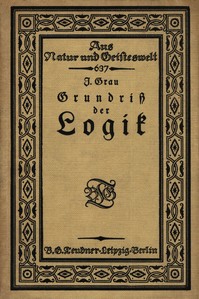
Grundriß der Logik by Kurt Joachim Grau
Let's be clear from the start: this isn't a novel. 'Grundriß der Logik' (Outline of Logic) by Kurt Joachim Grau is a philosophical text. Published in the 1930s, it's Grau's attempt to systematically lay out the principles of logical reasoning. Think of it as a guidebook for clear thinking, written by a scholar trying to establish firm ground in a discipline that questions the very nature of truth and argument.
The Story
There's no plot in the traditional sense. Instead, Grau builds his case step by step. He starts with the basic components of logic—concepts, judgments, and the rules of inference (how you get from one true statement to another). He explores different types of logical systems and how they relate to mathematics and scientific thought. The 'journey' is one of intellectual construction. Grau is methodically assembling a framework, showing how complex arguments can be broken down and analyzed according to formal rules. It's the story of a mind organizing chaos into a structured system.
Why You Should Read It
Reading this today is a unique experience. You're not just learning about logic; you're peering into the intellectual concerns of pre-WWII Europe. There's a palpable sense of a search for certainty in these pages. At a time of immense social and political upheaval, Grau is focused on the timeless tools of reason. It’s surprisingly accessible for a technical subject. Grau writes with clarity and purpose, avoiding unnecessary jargon where he can. You get a real sense of his conviction that understanding how we think correctly is a fundamental human endeavor. It's a quiet, powerful reminder of the value of disciplined thought.
Final Verdict
This book is perfect for philosophy students, history of science enthusiasts, or anyone with a deep curiosity about foundational ideas. It's not a light read, but it's a rewarding one if you're in the right headspace. You won't find thrilling twists, but you will find a concise, earnest attempt to map the architecture of rational argument. Think of it less as a book to race through and more as a seminar in print—a chance to sit with a thoughtful scholar from another era and work through some big questions about truth, proof, and the structure of our thoughts.
This text is dedicated to the public domain. Knowledge should be free and accessible.
Noah Moore
1 year agoAfter finishing this book, the arguments are well-supported by credible references. A true masterpiece.
Edward Ramirez
1 year agoIf you enjoy this genre, the emotional weight of the story is balanced perfectly. Thanks for sharing this review.
Joshua Lewis
2 years agoI had low expectations initially, however the pacing is just right, keeping you engaged. Highly recommended.
Ava Anderson
1 year agoSimply put, the content flows smoothly from one chapter to the next. Worth every second.
Ava Perez
1 year agoI didn't expect much, but it challenges the reader's perspective in an intellectual way. Worth every second.