1

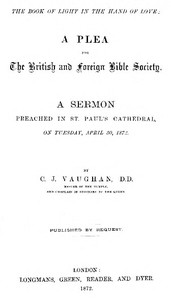
The Book of Light in the Hand of Love: A plea for the British and Foreign Bible Society A sermon preached in St. Paul's Cathedral, on Tuesday, April 30, 1872 — Reading Companion
(0 User reviews)
276
Project Gutenberg
2021
1872
Church of England -- Sermons -- 19th century; British and Foreign Bible Society -- Sermons; Bible. Epistle of John, 1st, I, 5, IV, 16 -- Sermons
Readers of public-domain and historical texts
Project Gutenberg digital edition
en
Edition facts
Words
7,334
Reading time
32 min
Text sections
1
Before opening The Book of Light in the Hand of Love: A plea for the British and Foreign Bible Society A sermon preached in St. Paul's Cathedral, on Tuesday, April 30, 1872 — Reading Companion, the edition data offers a quick orientation: 7,334 words, 32 min estimated reading time, and 1 detected text section.
The text analysis averages about 23.8 words per sentence, while the detected sections provide another way to judge how the source is divided.
Project Gutenberg metadata also associates the work with “Church of England -- Sermons -- 19th century,” connecting these edition facts with the source record’s subject description.
Source:
Project Gutenberg record #64471
In an 1872 sermon at St. Paul's Cathedral, C. J. Vaughan argues that the British and Foreign Bible Society embodies the twin apostolic principles 'God is Light' and 'God is Love,' weaving together theological reflection, ecumenical appeal, and national providentialism without doctrinal partisanship.
Read the complete public-domain text at its original source.
Read on Project GutenbergVaughan builds his plea around two verses from 1 John: 'God is Light' and 'God is Love.' He presents these not as slogans but as the organizing poles of Johannine theology, deliberately set against 'Calvinism, not Arminianism, not Romanism, and not Protestantism.' The sermon resists sectarian framing from its first paragraph, insisting that these principles are 'higher and deeper than any question which divides parties or distinguishes sects.' Yet Vaughan immediately qualifies this: he is not reducing theology to two maxims, nor denying that John's epistle has 'method or system or logical coherence.' The opening thus establishes a careful tension between simplicity and depth, accessibility and mystery—a pattern that recurs throughout the address.
Light and Love as Theological Poles
Vaughan unpacks 'God is Light' into four dimensions: truth, holiness, direction, and comfort. Each has a corresponding darkness—ignorance, corruption, error, misery—that prevails where God does not shine 'directly, not personally, not in Christ as the Saviour.' The metaphor is spatial and sensory: light can be 'set under a bushel' or blocked by 'the thick walls, the opaque windows, of the soul’s dwelling.' Vaughan does not treat these as abstract categories; he names concrete obstacles: 'Vice, superstition, false religion, cowardice, indifference.' The sermon’s structure mirrors its content: it moves from theological principle to practical application, from the nature of God to the work of the Bible Society as an instrument of that light.
The Society as an Agent of Providence
Vaughan presents the British and Foreign Bible Society as a providential instrument, noting that 'no Society, of this Church or that, for Christian Missions, can dispense with her aid in furnishing the divine material.' He cites the Society’s production of 'two hundred and fifty Versions' and 'more than one hundred millions of copies' as evidence of its reach. The tone shifts from theological exposition to institutional advocacy, but Vaughan anchors the appeal in the same dual principle: the Society distributes the 'Book of Light' through the 'Hand of Love.' He acknowledges past tensions with the Church of England—'it was ungrateful ... to accept help ... and to refuse thanks'—and welcomes the present reconciliation, calling the Society 'the friend, the “deaconess,” of one' Church while remaining 'the handmaid of all Churches.'
A Warning Against Complacency
Having celebrated the Society’s achievements, Vaughan pivots to a warning: 'Let us not be highminded, but fear!' He cautions that abundance of Scripture can breed 'an arrogance and a despite'—the Bible 'multiplied among us, till it is a very proverb of cheapness.' The question becomes personal: 'Is the Bible dear to your hearts, as well as plentiful in your homes?' Vaughan invokes the 'great orator of our time'—a Catholic priest speaking in Rome for a new Bible Society in Italy—as a striking example of ecumenical unity. The sermon closes with a vision of national blessing: 'The land of the Bible is a land of light, a land of peace, and a land of liberty,' but this is conditional on England's continued allegiance to 'the Christ of the Bible.'
Readers should note that Vaughan’s sermon is a specimen of Victorian pulpit oratory that blends doctrinal meditation with institutional apologetics. The excerpts reveal a preacher who moves fluidly between abstract principle and concrete application, but the full text may develop the argument further. Pay attention to how Vaughan handles the tension between the universal claims of the Gospel and the particular mission of a single society—and how he navigates the delicate ground between ecumenical openness and denominational loyalty.
The rain slid down the library window as I turned the final pages of Vaughan’s sermon, struck by how gently he folded light into love. That afternoon, a dog-eared volume on the shelf caught my eye—a quieter argument about census and congregation. I pulled down A Tract for the Times: The Church and the Census — Context and Discussion without thinking, and the two conversations seemed to hold each other, bound by the same patient concern for what a people believes.
There are no reviews for this eBook.
There are no comments for this eBook.
Reader reflection
Your personal reading reflection
Build a private reading journal entry for this title.
Your progress
0
/
10
2
How much did you enjoy the reading experience?
3
Would you encourage someone else to read it?
4
Did the language feel accessible?
5
Did any part of the book feel personally relevant?
6
What did you appreciate most?
7
Was the book what you thought it would be?
8
How much did the book move you?
9
In one sentence, what did you learn?
10