1

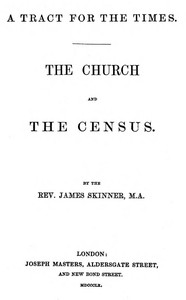
A Tract for the Times: The Church and the Census — Context and Discussion
(0 User reviews)
515
Project Gutenberg
2021
Not confirmed
Church and state -- Great Britain; Great Britain -- Census, 1861; Church of England -- History -- 19th century; Truth -- Religious aspects -- Christianity
Readers of public-domain and historical texts
Project Gutenberg digital edition
en
Edition facts
Words
7,488
Reading time
33 min
Text sections
1
The catalog record for A Tract for the Times: The Church and the Census — Context and Discussion provides practical reading context through 7,488 words, 33 min estimated reading time, and 1 detected text section.
The text analysis averages about 21.6 words per sentence, while the detected sections provide another way to judge how the source is divided.
Project Gutenberg metadata also associates the work with “Church and state -- Great Britain,” connecting these edition facts with the source record’s subject description.
Source:
Project Gutenberg record #64877
An 1860 tract by James Skinner arguing that Church of England members must publicly confess their faith, using the 1861 Census debate as a case study in religious witness versus political expediency.
Read the complete public-domain text at its original source.
Read on Project GutenbergJames Skinner’s 1860 tract opens by addressing fellow Church of England members baptized into the church, immediately framing the census as a test of religious witness. He draws a parallel to the Jewish Church and nation, which he says failed because they chose to desert God, preferring their own will and the kingdom of this world. The excerpt from Hosea 7 is used to illustrate how Israel mixed with idolaters and served God by halves. Skinner insists that external confession is as necessary as internal faith, quoting Christ’s words about confessing Him before men. The tract’s postscript reveals that the government had already yielded on the religious profession clause, which Skinner condemns as a sacrifice of justice to political influence. He concludes that Churchmen must not trust governments, as they prioritize power over principle.
The Jewish Church as a Type of Failure
Skinner’s argument rests on a typological reading of the Old Testament. He asserts that God set up the Jewish Church and nation as a visible token and witness to His truth, but they failed because they exercised their free choice to desert Him. The failure itself became a witness, he claims, because God’s law of always having a witness did not fail. The excerpt from Hosea 7 is cited to show how Israel’s princes fell, civil discord dried up legitimate authority, and the people mixed with idolaters, becoming “as a cake not turned.” Skinner uses this to warn that the Church of England could similarly fail if it withholds external service or confesses only in heart. The analogy is central to his case that the census debate is not merely administrative but a matter of divine witness.
Confession Before Men as a Divine Imperative
Skinner devotes significant space to Christ’s words in Matthew 10:32-38, which he calls “vital words.” He stresses that Christ does not say “he that confesseth Me in his heart” but “before men.” The passage is quoted at length, including the call to take up the cross and the warning that a man’s foes will be those of his own household. Skinner argues that it is not enough to hold the truth in one’s heart while remaining silent before the world. He links this to the census: refusing to declare one’s religious profession publicly is a form of denial. The tract thus transforms a statistical exercise into a spiritual test, demanding that Church members choose between worldly peace and divine allegiance.
The Government’s Capitulation as a Lesson
In a postscript added while the tract was in press, Skinner reports that the government had yielded on the religious profession clause, bowing to pressure from those who objected to being asked about religion. He notes that the government believed the clause was fair and necessary for legislative purposes but sacrificed its convictions for political influence. Skinner’s tone is scornful: “The Government loves its convictions a little. It loves political influence much.” He warns Churchmen not to put faith in governments, which are always ready to sacrifice justice to power. The tract’s object, he clarifies, was never to defend the clause itself but to argue that the Church must not trust governments. This postscript grounds the theological argument in a concrete political event, showing how the census debate exposed the tension between religious witness and state expediency.
Skinner’s tract is best read as a period piece that illuminates mid-Victorian anxieties about religious identity and state authority. The excerpts show a writer who moves fluidly between biblical exegesis and contemporary politics, using the census as a lens to examine the Church of England’s role as a public witness. Readers should note that the tract’s argument depends on a specific theological framework—the duty of external confession—and that the postscript provides a rare glimpse of the political context that prompted it. The work is not a general treatise on church-state relations but a focused intervention in a particular controversy.
I came across Skinner’s old tract again—that anxious plea for honest witness amid the 1861 census—and it put me in mind of a later, stranger courtroom, where C. B. Reynolds stood his ground on a different sort of faith. There’s a quiet thread between them: what it costs a person to speak plainly when the world wants comfortable silence. I found myself reading the Trial of C. B. Reynolds For Blasphemy, at Morristown, N. J., May 1887: Defence — Edition Insights that evening, and felt the same old ache.
There are no reviews for this eBook.
There are no comments for this eBook.
Reader reflection
What did you think of this book?
Answer a few questions and save a private reflection on this device.
Your progress
0
/
10
2
How did the book work for you overall?
3
Would you pass this book on to a friend?
4
How easy was the book to follow?
5
What was its emotional impact?
6
Would a second reading be valuable?
7
Would this book work well in a reading group?
8
Did you relate to its people, ideas, or situations?
9
In one sentence, what did you learn?
10