
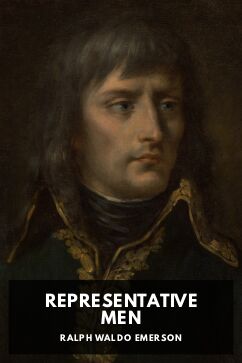
Representative Men - Ralph Waldo Emerson
Okay, let's be clear from the start: 'Representative Men' is not a novel. There's no plot in the traditional sense. Instead, think of it as a series of seven brilliant, connected essays. The first, 'Uses of Great Men,' sets the stage. Emerson argues that we need heroes and geniuses not to worship, but as lenses to focus our own potential. They are 'representative' because they express ideas and energies latent in all of us, just in a more powerful form.
The Story
The 'story' is the journey through six monumental minds. Emerson takes us on a tour of his personal hall of fame. We meet Plato the Philosopher, the man who gave us the very idea of thinking in systems. Then there's Swedenborg the Mystic, who saw the spiritual world in everything. Montaigne the Skeptic teaches us the value of honest doubt and self-examination. Shakespeare the Poet embodies the power of imagination to contain all of life. Napoleon the Man of the World represents raw, practical force and ambition. Finally, Goethe the Writer shows us the modern, well-rounded thinker who masters both books and life. Each portrait is less about dates and deeds, and more about the unique quality of mind each man possessed.
Why You Should Read It
You should read this because it makes you smarter about people. Emerson has this incredible gift for getting to the heart of what makes someone tick. His chapter on Shakespeare alone is worth the price of admission—he argues that Shakespeare's genius was his 'neutrality,' his ability to become every character without judging them. It’s a breathtaking idea. Reading Emerson on these men is like watching a master painter explain the brushstrokes of other masters. You start to see patterns in greatness. More importantly, the book is a massive pep talk. Emerson’s core message is that we shouldn't feel small next to these giants. We should feel energized. They are proof of what the human spirit can do.
Final Verdict
This book is perfect for curious readers who love ideas and don't mind a bit of a mental workout. It’s for anyone who’s ever read a history book or a biography and thought, 'Yes, but what made them *them*?' If you enjoy writers like Susan Sontag or modern public intellectuals who connect big ideas across time, you’ll find a kindred spirit in Emerson. It’s not a quick read—you’ll want to take it slow, maybe an essay at a time—but the insights stick with you. Approach it not as a history lesson, but as a conversation with a fiercely intelligent friend about what it means to live a meaningful life.
This historical work is free of copyright protections. It serves as a testament to our shared literary heritage.
Steven White
2 years agoSolid story.
George Nguyen
4 months agoThis book was worth my time since the pacing is just right, keeping you engaged. Thanks for sharing this review.
George Wilson
1 year agoWithout a doubt, the emotional weight of the story is balanced perfectly. One of the best books I've read this year.


Matthew Allen
1 year agoCompatible with my e-reader, thanks.