1

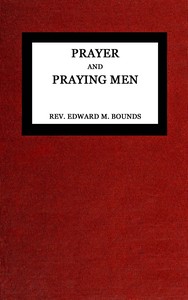
Prayer and praying men — Reading Notes
(0 User reviews)
156
Project Gutenberg
2023
Not confirmed
Prayer -- Christianity; Bible -- Prayers
Readers of public-domain and historical texts
Project Gutenberg digital edition
en
Edition facts
Words
38,474
Reading time
168 min
Text sections
21
Prayer and praying men — Reading Notes can be approached with a clearer sense of reading commitment from its source measurements: 38,474 words, 2 hr 48 min estimated reading time, and 21 detected text sections.
The text analysis averages about 21.2 words per sentence, while the detected sections provide another way to judge how the source is divided.
Project Gutenberg metadata also associates the work with “Prayer -- Christianity,” connecting these edition facts with the source record’s subject description.
Source:
Project Gutenberg record #70657
Edward M. Bounds examines prayer through Old Testament figures, focusing on Daniel's persistent prayer life. The book uses biblical narrative to illustrate prayer's role in crisis, revelation, and national deliverance, emphasizing secret prayer as a non-negotiable discipline.
Read the complete public-domain text at its original source.
Read on Project GutenbergEdward M. Bounds opens Prayer and Praying Men not with abstract theology but with a sustained, detailed portrait of Daniel as a model of unyielding prayer. The excerpts show Bounds moving through Daniel's life episode by episode: the refusal of the king's meat, the interpretation of Nebuchadnezzar's forgotten dream, the vision of the ram and he-goat, and the prayer of confession for the nation's captivity. Each scene is used to demonstrate a specific facet of prayer—concerted prayer, prayer for understanding, prayer that brings angelic messengers. The catalog subject "Prayer — Christianity" is accurate, but the excerpts reveal a work that is less a systematic treatise and more a series of character-driven homilies anchored in Old Testament narrative.
Daniel as the Archetype of the Praying Man
Bounds devotes the bulk of the excerpted material to Daniel, treating him not merely as a biblical figure but as a template for the praying life. The author highlights Daniel's refusal to "eat of the king's meat nor drink the king's wine" as a prelude to his prayer discipline—a decision made "without debating the question one moment." This characterization emphasizes resolve and immediacy over deliberation. Bounds then recounts the dream episode, where Daniel calls his three companions into "a concert of prayer" to seek divine revelation. The result—"the secret was revealed unto Daniel in a night vision"—is presented as a direct answer to united prayer. Throughout, Bounds's voice is exhortatory: he repeatedly draws a moral from the narrative, as when he declares, "Blessed is that nation which has praying men who can come to the help of civil rulers." The structure is consistently narrative-then-application, with little abstract theorizing.
Angels, Dreams, and the Mechanics of Answered Prayer
A striking feature of the excerpts is Bounds's matter-of-fact treatment of supernatural intermediaries. When Daniel prays for understanding of the ram-and-he-goat vision, the angel Gabriel is dispatched to "make this man to understand the vision." Bounds comments: "Angels have much to do with prayer. Praying men and the angels of heaven are in close touch with each other." This claim is presented as a straightforward observation, not a contested doctrine. Similarly, the king's dream is described as "a strange dream, the particular items of which passed from his memory," and the impossibility of human recall is contrasted with divine revelation through prayer. Bounds does not speculate on the psychology of prayer or the nature of angelic activity; he simply reports the biblical sequence and draws the lesson that "puzzling questions may often find an answer in the closet." The tone is confident, almost instructional.
Bounds's Rhetorical Method: Narrative, Exclamation, and Direct Address
The excerpts reveal a distinctive rhetorical blend. Bounds moves between compressed narrative summary—"Daniel appeared upon the stage of action"—and exclamatory asides: "And it all came about because there was a praying man there just at a critical time." He frequently addresses the reader with imperatives or implied applications, though the excerpts do not contain direct second-person commands. The prose is plain and repetitive in its structure: a biblical event is recounted, then its prayer lesson is stated. The introduction by Homer W. Hodge, included in the excerpts, offers a parallel portrait of Bounds himself as a man who "was praying and writing about Him all the time, except during the hours of sleeping." Hodge's comparison of Bounds to Wesley—"Wesley was preaching and riding all day. Bounds was praying and writing day and night"—suggests that the book's method of exemplar-based teaching reflects the author's own practice.
Readers approaching Prayer and Praying Men should expect a work that moves episode by episode through Scripture, drawing explicit prayer principles from each narrative. The excerpts suggest that Bounds assumes a reader familiar with the biblical stories but in need of focused application. The book's value lies less in originality of doctrine than in the sustained, concrete attention it gives to the prayer lives of specific figures—especially Daniel. Those seeking a systematic theology of prayer may find the approach repetitive; those looking for a devotional model rooted in biblical example will find ample material.
There’s a quiet comfort in watching Daniel’s steadfastness through Edward Bounds’s eyes—prayer as a slow, hidden labor. It reminds me of an old sermon I once stumbled across, Prospects of the Church of England A sermon preached in the Parish Church of Doncaster, on Sunday evening, August 30, 1868, on the occasion of the first offertory in — Background and Themes, about offertory and duty. Both seem to speak of faithfulness not for show, but simply because it’s owed.
There are no reviews for this eBook.
There are no comments for this eBook.
Reader reflection
How did this book work for you?
Your answers remain private and are stored only in this browser.
Your progress
0
/
10
2
What was your overall reaction to the book?
3
Would you pass this book on to a friend?
4
Did the language feel accessible?
5
Was the book moving at the right speed?
6
Was the book easy to understand?
7
Did you relate to its people, ideas, or situations?
8
How valuable was this book for your own interests?
9
What changed or sharpened your thinking?
10