1

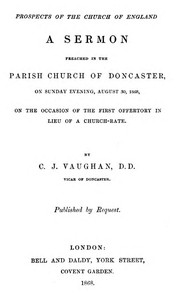
Prospects of the Church of England A sermon preached in the Parish Church of Doncaster, on Sunday evening, August 30, 1868, on the occasion of the first offertory in — Background and Themes
(0 User reviews)
55
Project Gutenberg
2020
1868
Church of England -- Sermons; Sermons, English -- 19th century; Bible. Kings, 2nd, XII, 7 -- Sermons
Readers of public-domain and historical texts
Project Gutenberg digital edition
en
Edition facts
Words
7,647
Reading time
34 min
Text sections
1
Prospects of the Church of England A sermon preached in the Parish Church of Doncaster, on Sunday evening, August 30, 1868, on the occasion of the first offertory in — Background and Themes can be approached with a clearer sense of reading commitment from its source measurements: 7,647 words, 34 min estimated reading time, and 1 detected text section.
The text analysis averages about 22.8 words per sentence, while the detected sections provide another way to judge how the source is divided.
Project Gutenberg metadata also associates the work with “Church of England -- Sermons,” connecting these edition facts with the source record’s subject description.
Source:
Project Gutenberg record #63763
A sermon preached in 1868 at Doncaster Parish Church on the first offertory replacing a church-rate, using 2 Kings xii.7 to address the Church of England's prospects through a detailed historical parallel with the Temple's repair.
Read the complete public-domain text at its original source.
Read on Project GutenbergThis sermon, preached on August 30, 1868, at Doncaster Parish Church, marks the first offertory in lieu of a church-rate. Charles John Vaughan, the vicar, uses the text 'Why repair ye not the breaches of the house?' (2 Kings xii.7) to frame a discussion of the Church of England's condition. The preface notes that the sermon was originally delivered without expectation of wider notice, but interest in the subject prompted publication. Vaughan acknowledges that the opening sentences allude to earlier sermons, indicating this is part of a series.
Historical Parallel and Scriptural Context
Vaughan opens by tracing a narrative from the northern to the southern kingdom of Israel, focusing on the period after Elijah and Elisha. He describes how Baal-worship, extirpated in the north by Jehu, found refuge in Judah under Athaliah, a daughter of Ahab. The preacher recounts Athaliah's seizure of power after her son Ahaziah's death, noting her destruction of 'all the seed royal.' He observes that 'crime is seldom quite prosperous' and that something—often a child—survives to become a testimony. This historical sketch sets up the metaphor of the Temple's breaches as a call to repair.
The Breaches of the Soul
Vaughan shifts from the literal Temple to the soul as a 'House' that 'ought to lie four-square' and be 'gleaming with the fire of the Holy Ghost.' He describes the soul as 'all jagged and disordered and spotted and sin-stained,' with its altar-fire going out every half-hour. This leads to a series of imagined responses to the question 'Why repair ye not the breaches?' The first answer, 'I cannot,' is countered by the Gospel promise that 'God giveth more grace.' The second, 'I need not,' is criticized as a misuse of Christ's sacrifice to excuse sin. The third, 'I will not,' is presented as the most hopeless, a willful refusal of the Gospel.
Rhetorical Structure and Audience
Vaughan's sermon employs a direct, confrontational style, addressing the congregation with questions and hypothetical answers. He uses vivid imagery: 'a darkness that may be felt to settle down upon its chambers' and 'some delicious delirious lust' creeping in through a 'secret neglected postern.' The sermon ends with a prayer for God to 'make us feel' and bring repentance. The preface reveals that the sermon was published at the request of congregation members, and the text includes a list of Vaughan's other works, suggesting his established reputation as a preacher and author.
Readers should note that this sermon is a single, continuous argument rather than a series of points. Vaughan's use of the Old Testament narrative is not merely illustrative but structural, providing a framework for his exhortation. The sermon's occasion—the first offertory replacing a church-rate—is a specific local event, but Vaughan addresses broader questions of church renewal and personal piety. The text is best approached as a historical document of Victorian Anglican preaching, with attention to its rhetorical strategies and theological assumptions.
Reading this old sermon about the Temple’s repair, I found myself thinking of how we patch things together—faith, memory, ordinary life. It reminded me, quietly, of The Belief in Immortality and the Worship of the Dead, Volume 2 (of 3) The Belief Among the Polynesians — Reading Notes, where the dead are so present they’re almost part of the masonry. Strange, how each era just keeps rebuilding around its own grief.
There are no reviews for this eBook.
There are no comments for this eBook.
Reader reflection
How did this book work for you?
Your answers remain private and are stored only in this browser.
Your progress
0
/
10
2
Did this book hold your interest?
3
Would you encourage someone else to read it?
4
How much effort did this book require?
5
Is this a title worth rereading?
6
How much did the book move you?
7
Did the story or argument move comfortably?
8
Did the book give you something worth debating?
9
What did this book teach you most?
10