1

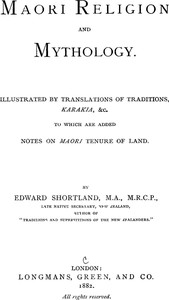
Maori Religion and Mythology Illustrated by Translations of Traditions, Karakia, &c., to Which Are Added Notes on Maori Tenure of Land — Key Ideas to Explore
(0 User reviews)
281
Project Gutenberg
2013
Not confirmed
Māori (New Zealand people) -- Religion; Mythology, Maori; Land tenure (Māori law)
Readers of public-domain and historical texts
Project Gutenberg digital edition
en
Edition facts
Words
31,179
Reading time
136 min
Text sections
11
Before opening Maori Religion and Mythology Illustrated by Translations of Traditions, Karakia, &c., to Which Are Added Notes on Maori Tenure of Land — Key Ideas to Explore, the edition data offers a quick orientation: 31,179 words, 2 hr 16 min estimated reading time, and 11 detected text sections.
The text analysis averages about 17.6 words per sentence, while the detected sections provide another way to judge how the source is divided.
Project Gutenberg metadata also associates the work with “Māori (New Zealand people) -- Religion,” connecting these edition facts with the source record’s subject description.
Source:
Project Gutenberg record #42218
Edward Shortland's 1882 work presents Maori traditions, karakia (chants), and cosmogony, collected from tohunga (priests) in the 19th century. The text includes detailed accounts of land discovery and naming, revealing how myth, ritual, and territorial claims intertwine. Shortland's preface describes his careful dictation method, aiming to preserve authentic oral storytelling.
Read the complete public-domain text at its original source.
Read on Project GutenbergEdward Shortland's Maori Religion and Mythology (1882) opens with a preface that details his method of collecting manuscripts from Maori informants, all but one of whom were deceased by the time of publication. Shortland instructed his sources to tell their tales as if to their own people, using the same words they would in a sacred house during storms, believing this would quiet the spirits of the sky. He never interrupted the dictation with questions, later reading back his transcription for correction. This approach aimed to preserve the oral texture of the narratives, though the resulting text is inevitably filtered through Shortland's translation and editorial choices.
Cosmogony and the Tohunga's Secret
Chapter II contains a tradition of Maori cosmogony that Shortland describes as more detailed than any he had encountered elsewhere. The informant, educated to become a tohunga (priest) but later a professing Christian, dictated the narrative at night, unknown to his people, under a promise that Shortland would not read it aloud to them. When Shortland later revisited New Zealand, he learned the man had died soon after his departure, and his death was attributed to the anger of his family's atua (spirit) for having made noa (common) what was tapu (sacred). The informant himself confessed this as the cause of his illness. This episode illustrates the tension between Christian conversion and traditional Maori beliefs, as well as the risks of transmitting sacred knowledge outside proper channels.
Naming and Claiming Land
Chapters V and VI recount the journeys of Ihenga, a legendary figure who discovers and names lakes, hot springs, and other landmarks. The narrative is dense with place-names and their etymologies, such as Te Roto-iti-kite-a-Ihenga (the small lake discovered by Ihenga). When Ihenga returns to his chief Kahu, he describes the location as beyond the sixth range of hills, to which Kahu replies, 'Oh! it is near.' The text then describes a ceremony called Turakanga, involving ritual mounds, a woman plunging into a river, and the communal eating of kiwi and inanga. Kahu murmurs, 'Ho! ho! what prime food for my grandchild.' Later, Kahu tells Ihenga, 'Go, seek lands for your child,' explicitly linking exploration and naming to inheritance and territorial rights.
Ritual, Tapu, and the Natural World
The excerpts repeatedly show how ritual actions and tapu govern interactions with the environment. In one episode, Ihenga mistakes steam from hot springs for smoke from a fire, believing the land already claimed. He later finds a net and a tuahu (sacred place for the net) and carries off the catch, an act that likely breaches tapu. The text also describes the use of snares to catch shags, which fly off with the pole, and Ihenga's prediction that they will alight on Te Motu-tapu-a-Tinirau (the sacred island of Tinirau). These details weave together practical knowledge of fishing and hunting with a worldview where natural phenomena are imbued with spiritual significance and where human actions must be carefully calibrated to avoid transgressing sacred boundaries.
Readers should approach Shortland's text as a colonial-era record that preserves fragments of Maori oral tradition while inevitably reshaping them. The preface's account of the informant's death and the secret dictation highlights the ethical complexities of such documentation. Pay attention to the interplay between narrative and ritual, and to how place-names encode both history and claims of ownership. The appendix on Maori terms of relationship may also offer insight into the social structures underlying these traditions.
I keep thinking about how Shortland sat with those elders, letting their words shape the page, and it reminds me of something quiet I found in Professor W. G. Elmslie, D.D.: Memoir and Sermons — Background and Themes — that same careful holding of a voice, the way a person’s whole life can feel sacred when someone bothers to listen properly. It lingered with me gently.
There are no reviews for this eBook.
There are no comments for this eBook.
Reader reflection
How will you remember this book?
Save your reaction, strongest insight, and memorable passage.
Your progress
0
/
10
2
How much did you enjoy the reading experience?
3
Would you encourage someone else to read it?
4
How much effort did this book require?
5
Is this a title worth rereading?
6
How distinctive were its ideas or approach?
7
How understandable was the text?
8
How valuable was this book for your own interests?
9
What changed or sharpened your thinking?
10