1

Professor W. G. Elmslie, D.D.: Memoir and Sermons — Background and Themes
(0 User reviews)
600
Project Gutenberg
2019
Not confirmed
Sermons, English -- 19th century; Elmslie, William Gray, 1848-1889; Theologians -- Scotland -- Biography
Readers of public-domain and historical texts
Project Gutenberg digital edition
en
Edition facts
Words
105,362
Reading time
459 min
Text sections
11
The catalog record for Professor W. G. Elmslie, D.D.: Memoir and Sermons — Background and Themes provides practical reading context through 105,362 words, 7 hr 39 min estimated reading time, and 11 detected text sections.
The text analysis averages about 23.0 words per sentence, while the detected sections provide another way to judge how the source is divided.
Project Gutenberg metadata also associates the work with “Sermons, English -- 19th century,” connecting these edition facts with the source record’s subject description.
Source:
Project Gutenberg record #60348
This editorial note examines how the memoir and sermon excerpts in Elmslie's volume guide a first reading, focusing on the editorial framing, the preacher's direct address, and the interplay of biography and theology.
Read the complete public-domain text at its original source.
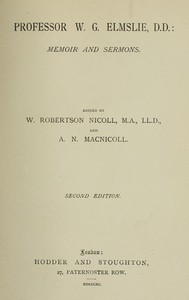
Read on Project GutenbergThe volume opens with an advertisement by W. Robertson Nicoll, who clarifies his role: he wrote the memoir except for sections on Regent Square and Willesden contributed by A. N. Macnicoll. Macnicoll also selected the sermons, noting that Elmslie seldom fully wrote them out and that some required “considerable amplification.” This editorial candor sets expectations: the sermons are reconstructed from notes or shorthand reports, with wording preserved “as far as possible.” A first reader thus encounters a work shaped by two editors, each explicitly responsible for different parts.
Editorial Framing and the Memoir’s Purpose
The advertisement states that “abundant material for a larger biography” existed but was set aside to keep the volume affordable and to let Elmslie’s own work predominate. This decision shapes the reader’s experience: the memoir is brief, and the sermons form the bulk. Nicoll acknowledges help from Principal Dykes and other contributors, but the focus remains on Elmslie. The reader should note that the memoir is not a full biography but a selective introduction, designed to contextualize the sermons that follow.
The Preacher’s Voice in the Sermons
In the sermon excerpt, Elmslie addresses listeners directly: “No, do not blame yourself if you are often very weary.” He uses the wilderness wandering of Israel as an extended metaphor, shifting between sympathy and challenge. He warns against murmuring, but reframes God’s response: “He does not resent the ignorance, with the mixture of superstition.” The language is colloquial and urgent, with rhetorical questions and imperatives. A first reader will notice that Elmslie’s sermons are not formal lectures but pastoral exhortations, aiming to comfort and provoke.
The Interplay of Biography and Theology
The memoir and sermons are presented as complementary. The memoir provides the life context—Elmslie’s roles as professor and preacher—while the sermons reveal his theological concerns. In the excerpt, he emphasizes human responsibility (“Is not the blame, at least somewhat, your own?”) and the value of hardship: “It was years of wandering in the wilderness that turned those Egyptian slaves into the dauntless warriors.” This theme of redemptive suffering likely reflects Elmslie’s own experiences, though the excerpts do not detail them. Readers should consider how the biographical frame illuminates the sermons’ pastoral urgency.
Structure and Selection of Sermons
The table of contents lists eleven sermons, each with a biblical text. The excerpted sermon on the wilderness is not among those listed, suggesting it may be from a later section or an unlisted address. Macnicoll’s note that he printed sermons “as they were delivered” from shorthand reports indicates a commitment to authenticity. The inclusion of two “Sunday Readings” from Good Words and an article on Genesis from the Contemporary Review shows the range of Elmslie’s writing. A first reader might track how the sermons’ structure—often starting with a text, then moving to application—reflects his homiletic method.
Reading the Wilderness Metaphor
The extended wilderness metaphor dominates the excerpt. Elmslie compares the Israelites’ forty years to personal struggles, warning against blaming God or Moses. He insists that hardship builds character: “Do we not need hardness as well as lightness in our inner lives?” The metaphor recurs with variations—the Bastille prisoners, the rain and sunshine, the musical scale. This rhetorical strategy suggests that Elmslie’s sermons often hinge on a single, developed image. Readers should watch for similar sustained metaphors in other sermons, as they reveal his method of making biblical narratives immediate.
This volume offers a dual perspective: the memoir frames the man, the sermons frame his message. A first reader benefits from reading the memoir first, but the sermons can stand alone. The editorial notes by Nicoll and Macnicoll provide transparency about the text’s construction, inviting trust. Pay attention to how Elmslie balances comfort and challenge, and how his metaphors bridge ancient texts and contemporary life.
Reading Elmslie’s memoir, I kept noticing how the editor’s gentle hand shaped the preacher’s words, framing them so they felt like quiet conversation rather than proclamation. It reminded me of another editorial voice, one wrestling with scripture’s silences. That same tender, interpretive presence lives in The Woman's Bible — A Closer Reading, where each annotation feels less like argument and more like a whispered accompaniment. Strange, how two such different books can share that soft, guiding touch.
There are no reviews for this eBook.
There are no comments for this eBook.
Reader reflection
How will you remember this book?
Save your reaction, strongest insight, and memorable passage.
Your progress
0
/
10
2
How did the book work for you overall?
3
Would you recommend this book to another reader?
4
Did the language feel accessible?
5
Did you gain anything practical from the text?
6
How did the reading compare with what you expected?
7
How personally connected did you feel to the book?
8
Did the book offer a fresh perspective?
9
In one sentence, what did you learn?
10