
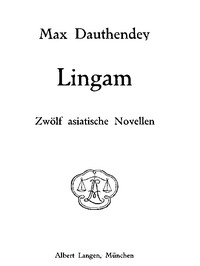
Lingam: Zwölf asiatische Novellen by Max Dauthendey
Published in 1909, Lingam is a collection of twelve short stories, or novellas, all set in Asia. The author, Max Dauthendey, was a German poet and painter associated with the Symbolist movement. Here's the twist: when he wrote these stories, he had never traveled to the continents he was writing about. He built his versions of Japan, India, and Indonesia entirely from research, art, and his own vivid imagination.
The Story
There isn't one single plot. Instead, you get a dozen different windows into Dauthendey's imagined East. One story might be a quiet, poetic romance set in a Japanese garden. The next could be a tense drama about colonial encounters in the Dutch East Indies. Another might dip into folklore, featuring spirits and local legends. Characters range from geishas and monks to European travelers and mythical beings. The common thread is the setting—a lush, atmospheric, and entirely constructed Asia that feels both familiar and fantastical.
Why You Should Read It
Forget reading this as a straight-up guide to Asian culture. You read it for the unique, almost paradoxical experience. It's like watching a masterful stage play where you know the backdrop is painted, but the emotions feel real. Dauthendey's prose is lush and sensory—you can almost smell the incense and feel the silk. The stories themselves are often simple but charged with feeling. The real intrigue for me was the meta-layer: you're constantly aware of the author's position, trying to connect across a huge cultural gap. It makes you think about how we understand other places, and the power (and pitfalls) of artistic imagination. It's far from perfect, but it's genuinely interesting.
Final Verdict
This book is a niche gem. It's perfect for readers who love literary history, enjoy beautiful descriptive writing, and don't mind a bit of historical baggage. If you're looking for authentic, own-voices Asian literature, this isn't it. But if you're fascinated by the era of early 20th-century German literature, or curious about how artists try to capture the 'foreign,' Lingam offers a compelling and conversation-starting read. Think of it as a historical artifact that's also a pretty good story collection.
There are no legal restrictions on this material. Feel free to use it for personal or commercial purposes.
Emma Thomas
1 year agoThe fonts used are very comfortable for long reading sessions.
Barbara Martin
4 months agoVery helpful, thanks.
Jessica Allen
5 months agoSimply put, the arguments are well-supported by credible references. I couldn't put it down.
Linda Perez
1 year agoA must-have for anyone studying this subject.
Donna Jones
11 months agoI stumbled upon this title and the flow of the text seems very fluid. Absolutely essential reading.