1

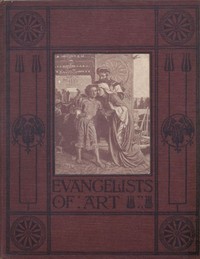
Evangelists of Art: Picture-Sermons for Children — Story, Setting & Ideas
(0 User reviews)
325
Project Gutenberg
2009
Not confirmed
Sermons, American; Children's sermons; Christian art and symbolism -- Juvenile literature
Readers of public-domain and historical texts
Project Gutenberg digital edition
en
Edition facts
Words
14,582
Reading time
64 min
Text sections
2
The source record for Evangelists of Art: Picture-Sermons for Children — Story, Setting & Ideas measures this digital text at 14,582 words, 1 hr 4 min estimated reading time, and 2 detected text sections.
The text analysis averages about 20.5 words per sentence, while the detected sections provide another way to judge how the source is divided.
Project Gutenberg metadata also associates the work with “Sermons, American,” connecting these edition facts with the source record’s subject description.
Source:
Project Gutenberg record #30220
James Patrick's 1903 collection of eight picture-sermons for children, each keyed to a specific painting by artists such as Holman Hunt, G.F. Watts, and Noël Paton, blending art criticism with biblical and historical instruction.
Read the complete public-domain text at its original source.
Read on Project GutenbergJames Patrick's Evangelists of Art: Picture-Sermons for Children (1903) pairs eight paintings with expository sermons aimed at young readers. The opening chapter on Holman Hunt's "Christ in the Temple" immediately establishes a method: Patrick describes the painting's architectural details—"graceful pillars," "lamps of beautiful metal-work," a "lattice-screen"—before connecting them to the biblical narrative. He notes the unfinished Temple building visible in the background, with "scaffolding of the masons" and a crane, grounding the sacred scene in historical labor. This attention to visual evidence, rather than abstract moralizing, characterizes the book's approach.
Painting as Exegetical Tool
Patrick does not treat paintings as mere illustrations; he uses them as primary texts for theological reflection. In the chapter on "Luther at Erfürt" by Sir J. Noël Paton, the sermon likely draws on the painting's depiction of Luther's monastic cell or study—a space of intellectual and spiritual struggle. Patrick's method is to describe what the eye sees—"the interior of a spacious portico," "the farther end is closed by an ornamental lattice-screen"—and then to ask what these details signify. For instance, the beggar on the steps in Hunt's painting is noted not as a random figure but as a reminder of poverty and need within the Temple precincts. This technique trains children to read paintings as layered narratives, where every element carries meaning.
Martyrs and Reformers as Visual Subjects
Several sermons focus on figures of Protestant martyrdom. The chapter on "Wishart Dispensing the Sacrament before His Martyrdom" by W. Q. Orchardson recounts the historical George Wishart's final breakfast, where he blessed bread and wine after being denied the sacrament by Cardinal Beaton. Patrick emphasizes Wishart's words: "I beseech you in the name of God... to be silent a little while, till I have made a short exhortation." The painting presumably captures this domestic yet charged scene—a governor's family at table, a soldier at the door. Patrick's narrative fills in the backstory: Wishart's plague ministry in Dundee, his teaching of the Greek New Testament, and his execution at the stake. The sermon thus becomes a history lesson anchored by a single painted moment.
Classical and Allegorical Figures
Not all chapters are biblical or historical. Patrick includes paintings of classical myths: Lord Leighton's "Hercules Wrestling with Death for the Body of Alcestis" and G. F. Watts's "Orpheus and Eurydice." These choices suggest an expansive definition of "evangelist"—artists who convey moral truths through pagan stories. The sermon on "The Rider on the White Horse" (also by Watts) likely interprets the apocalyptic image from Revelation, while "The Man with the Muck-Rake" (after Paton) draws on Bunyan's Pilgrim's Progress. Patrick's willingness to move between biblical, historical, classical, and literary sources indicates a curriculum aimed at cultural literacy as much as religious instruction.
Readers approaching Evangelists of Art should note that Patrick's sermons are tightly bound to the paintings he describes; the book is best read with reproductions of the artworks at hand. The author's voice is instructive but not condescending, assuming children can follow detailed descriptions of architecture, costume, and composition. The volume offers a window into early twentieth-century Protestant pedagogy, where art served as a bridge between scripture and everyday life.
That rainy afternoon, I lingered over the Watts sermon, watching the children in the story grapple with grace they couldn’t earn. The book’s quiet insistence on mercy stayed with me. Later, rain against the window, I found myself reaching for Prayer and praying men — Reading Notes, almost accidentally, as if one volume’s stillness had led me to another’s.
There are no reviews for this eBook.
There are no comments for this eBook.
Reader reflection
Your personal reading reflection
Build a private reading journal entry for this title.
Your progress
0
/
10
2
Did this book hold your interest?
3
Would you recommend this book to another reader?
4
What was the reading difficulty like?
5
Did the book offer a fresh perspective?
6
Did any part of the book stay with you emotionally?
7
Did it raise ideas you would like to talk about?
8
Did the book meet your expectations?
9
What did this book teach you most?
10