1

The Bible and Polygamy: Does the Bible Sanction Polygamy? — A Reader’s Guide
(0 User reviews)
183
Project Gutenberg
2016
Not confirmed
Bible -- Criticism, interpretation, etc.; Latter Day Saint churches -- Doctrines; Polygamy -- Religious aspects
Readers of public-domain and historical texts
Project Gutenberg digital edition
en
Edition facts
Words
58,287
Reading time
254 min
Text sections
5
This digital edition of The Bible and Polygamy: Does the Bible Sanction Polygamy? — A Reader’s Guide is described by source-level measurements including 58,287 words, 4 hr 14 min estimated reading time, and 5 detected text sections.
The text analysis averages about 24.7 words per sentence, while the detected sections provide another way to judge how the source is divided.
Project Gutenberg metadata also associates the work with “Bible -- Criticism, interpretation, etc.,” connecting these edition facts with the source record’s subject description.
Source:
Project Gutenberg record #51140
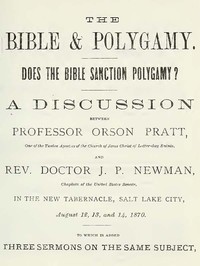
A record of an 1870 public debate between LDS apostle Orson Pratt and Methodist chaplain J.P. Newman on whether the Bible sanctions polygamy, supplemented by sermons and correspondence. The text reveals clashing hermeneutics—Pratt's literal, contextual reading versus Newman's moral and typological interpretation—centered on Hebrew terms, Old Testament law, and New Testament teachings.
Read the complete public-domain text at its original source.
Read on Project GutenbergThe volume opens with a formal exchange of letters between Brigham Young and Reverend J.P. Newman, revealing that the debate arose from a newspaper article Newman interpreted as a challenge. Young disavows authorship, noting the paper was not church-owned. This initial friction sets the stage for a dispute grounded not only in scriptural interpretation but also in institutional authority and public perception. The debate itself, held in Salt Lake City's New Tabernacle in August 1870, pits Orson Pratt, an LDS apostle, against Newman, chaplain of the U.S. Senate. Their arguments hinge on precise Hebrew wording, the scope of Old Testament laws, and the applicability of New Testament passages—particularly those on divorce and marriage—to the question of polygamy.
The Disputed Meaning of <em>Ishah</em> and the Limits of Law
Pratt repeatedly challenges Newman's translation of the Hebrew ishah, arguing that it should be rendered “wife” rather than “one” in certain contexts. He insists that if ishah means “wife,” then the laws in Exodus and Deuteronomy that address a man's actions toward a woman apply to married men as well as unmarried ones. Pratt uses this to counter Newman's claim that such laws implicitly forbid polygamy. He points to the law of rape and the law of enticing a maid, asking: “Will any person pretend to say that a married man is not a man?” For Pratt, the general language of these passages proves they are not limited to bachelors. Newman's counterargument, based on a marginal reading in Leviticus, is dismissed by Pratt as a “forlorn hope.” The debate thus turns on whether the Bible's legal codes are restrictive or permissive by default.
The King's Horses and the Question of Multiplication
Pratt addresses the objection that Deuteronomy 17:17 forbids a king from multiplying wives. He notes that the same verse also forbids multiplying horses, and asks rhetorically whether that means a king could have only one horse. The absurdity, he argues, shows that “multiply” means to accumulate excessively, not to take more than one. He then turns to the story of Ruth and Boaz, citing Josephus to claim that Boaz's unnamed kinsman—who had the right to marry Ruth—was already married. This, Pratt contends, proves that the levirate marriage law applied to married men. Newman's reliance on Josephus is turned against him: if the historian is credible here, then his testimony supports polygamy. The exchange illustrates how both debaters mine the same sources for opposing conclusions, with each side accusing the other of selective reading.
Divorce, Adultery, and the Silence of Malachi
Pratt examines Malachi 2:16 and Matthew 5:32, arguing that these passages condemn divorce, not polygamy. He states that Malachi's declaration that God hates “putting away” is about protecting wives from arbitrary dismissal, not about limiting the number of wives a man may have. Similarly, Jesus' teaching on divorce in Matthew 5 is interpreted by Pratt as a prohibition against remarriage after an unlawful divorce, not as a ban on multiple concurrent marriages. He reasons that a man who puts away his wife unjustly becomes an adulterer and thus forfeits the right to remarry, but this says nothing about a man who never divorces. The absence of any explicit condemnation of polygamy in these passages is, for Pratt, a significant silence. Newman's position, though not fully excerpted, appears to rely on a moral or typological reading of Genesis 2:24—that marriage was instituted as monogamous—a claim Pratt does not directly engage in the available text.
Readers should attend to the rhetorical structure of the debate: each speaker frames his opponent's position as an innovation or a departure from plain scripture. The excerpts show Pratt emphasizing lexical precision and legal application, while Newman (inferred from Pratt's rebuttals) appeals to the Edenic ideal and the moral trajectory of the Bible. The appended sermons and correspondence may further illuminate how these arguments were received within the LDS community. The volume is best approached as a primary source for nineteenth-century American religious controversy, not as a neutral exegetical study.
I keep thinking about that old debate—how two people can read the same words and find such different truths. It stayed with me longer than expected. The same quiet feeling came back reading The Gospel of St. John: A Series of Discourses. New Edition — Reading Notes, where each discourse feels like someone gently unfolding a verse rather than arguing over it. Strange how a book can feel like a resting place.
There are no reviews for this eBook.
There are no comments for this eBook.
Reader reflection
How did this book work for you?
Your answers remain private and are stored only in this browser.
Your progress
0
/
10
2
How did the book work for you overall?
3
Would you recommend this book to another reader?
4
Did the language feel accessible?
5
Would you like to discuss this book with someone?
6
Was the book moving at the right speed?
7
How original did the book feel?
8
What was the strongest part of the book?
9
What did this book teach you most?
10