1

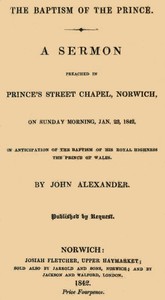
The Baptism of the Prince: A Sermon Preached ... on Sunday morning, Jan. 23, 1842, in anticipation of the baptism of His Royal Highness, the Prince of Wales. — Background and Themes
(0 User reviews)
907
Project Gutenberg
2020
Not confirmed
Baptism; Bible. Mark X, 13-16 -- Sermons
Readers of public-domain and historical texts
Project Gutenberg digital edition
en
Edition facts
Words
11,181
Reading time
49 min
Text sections
2
For The Baptism of the Prince: A Sermon Preached ... on Sunday morning, Jan. 23, 1842, in anticipation of the baptism of His Royal Highness, the Prince of Wales. — Background and Themes, the stored edition analysis reports 11,181 words, 49 min estimated reading time, and 2 detected text sections.
The text analysis averages about 31.6 words per sentence, while the detected sections provide another way to judge how the source is divided.
Project Gutenberg metadata also associates the work with “Baptism,” connecting these edition facts with the source record’s subject description.
Source:
Project Gutenberg record #63331
John Alexander's 1842 sermon, occasioned by the baptism of the Prince of Wales, argues for infant baptism while rejecting baptismal regeneration, using the royal event to address subjects, parents, and children with a nonconformist perspective.
Read the complete public-domain text at its original source.
Read on Project GutenbergJohn Alexander's sermon, preached on January 23, 1842, at Prince's Street Chapel in Norwich, was timed to anticipate the baptism of the Prince of Wales. The published text includes a preface in which Alexander states that the discourse is not a complete treatise but an outline of one branch of an argument, aimed not at those who deny infant baptism but at those who practice it, to remind them of privilege and responsibility. He explicitly avoids discussing the mode of baptizing, focusing instead on what he considers more important matters.
A Sermon Shaped by a Royal Occasion
The sermon's occasion—the baptism of the heir apparent—gives it a specific public character. Alexander addresses his congregation as subjects, parents, and children, directly linking the royal event to domestic and ecclesiastical duties. He writes in the preface that the discourse was occasioned by the baptism of the Prince of Wales, and this framing is sustained throughout. The royal baptism is not merely a pretext but a lens through which Alexander examines the meaning of infant baptism for all Christians. He uses the prince's baptism to urge his hearers to consider their own responsibilities, both as citizens and as members of the church.
A Clear Distinction: Baptismal Regeneration Rejected
Alexander devotes a substantial portion of the sermon to refuting the doctrine of baptismal regeneration, which he calls unscriptural and injurious. He argues that no New Testament writer ascribes spiritual efficacy to water baptism, citing John the Baptist's distinction between water and Spirit baptism, and Paul's statement that Christ sent him not to baptize but to preach. He warns that substituting ceremony for faith leads to a mechanical religion, where the worldly-minded think themselves saved because they have been baptized. This critique is central to his argument and reflects his nonconformist stance.
Nonconformity as a Conscientious Duty
Alexander explicitly connects his rejection of baptismal regeneration to the necessity of nonconformity with the Church of England. He references the 1662 Prayer Book and the two thousand clergymen who refused to give unfeigned assent to its doctrines, choosing poverty and persecution instead. For Alexander, conformity would be a wilful sin. This historical reference grounds his argument in the tradition of Dissent, making the sermon not only a theological exposition but also a defense of nonconformist identity. He urges his hearers to value what is scriptural in the established church while maintaining their separation.
Infant Baptism as a Domestic and Ecclesial Practice
In the preface, Alexander describes infant baptism as a practice he warmly loves, both as a parent and as a pastor. He emphasizes the intimate connection between baptized households and church membership, urging that children be trained for communion by both parent and pastor. He quotes Philip Henry: 'If infant baptism were more improved, it would be less disputed.' This practical, pastoral concern runs through the sermon, as Alexander seeks to remind practitioners of their privilege and responsibility. The royal baptism serves as a prompt for this domestic and ecclesial reflection.
Readers approaching this sermon should note that it is not a comprehensive treatise but an occasional discourse, shaped by a specific event and audience. Alexander's arguments are directed primarily to those who already practice infant baptism, not to opponents. The sermon's structure moves from the royal occasion to doctrinal critique to practical application, and its nonconformist convictions are explicit. Pay attention to how Alexander uses the prince's baptism to address his congregation as subjects, parents, and children, and how he distinguishes his position from that of the established church.
There are mornings when the old sermon on the Prince’s baptism still feels like a quiet conversation about beginnings—how a life is claimed before it can choose. And then, shelved across the aisle, The Fallen Star, or, the History of a False Religion by E.L. Bulwer; And, A Dissertation on the Origin of Evil by Lord Brougham — Inside the Classic whispers of what happens when that claim turns to shadow. They never speak, but I’ve watched them lean toward each other for decades—innocence and its long, patient question.
There are no reviews for this eBook.
There are no comments for this eBook.
Reader reflection
What did you think of this book?
Answer a few questions and save a private reflection on this device.
Your progress
0
/
10
2
How did the book work for you overall?
3
Would you recommend this book to another reader?
4
How demanding did the text feel?
5
Would you start a conversation about this book?
6
Which part made the strongest impression?
7
Would you read this book again?
8
Could you follow the author’s main argument?
9
Which lesson or insight stayed with you?
10