1

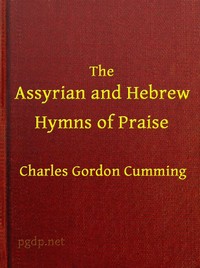
The Assyrian and Hebrew Hymns of Praise — Background and Themes
(0 User reviews)
1097
Project Gutenberg
2015
Not confirmed
Bible. Psalms -- Criticism, interpretation, etc.; Hymns, Akkadian -- History and criticism; Comparative literature -- Hebrew and Assyro-Babylonian; Comparative literature -- Assyro-Babylonian and Hebrew
Readers of public-domain and historical texts
Project Gutenberg digital edition
en
Edition facts
Words
54,264
Reading time
236 min
Text sections
13
For The Assyrian and Hebrew Hymns of Praise — Background and Themes, the stored edition analysis reports 54,264 words, 3 hr 56 min estimated reading time, and 13 detected text sections.
The text analysis averages about 18.5 words per sentence, while the detected sections provide another way to judge how the source is divided.
Project Gutenberg metadata also associates the work with “Bible. Psalms -- Criticism, interpretation, etc.,” connecting these edition facts with the source record’s subject description.
Source:
Project Gutenberg record #47864
A scholarly comparison of Assyrian and Hebrew hymns of praise, examining literary forms, theological concepts, and self-introductions of deities, based on textual analysis of cuneiform and biblical sources.
Read the complete public-domain text at its original source.
Read on Project GutenbergCharles Gordon Cumming's study compares Assyrian and Hebrew hymns of praise by analyzing their literary forms and theological content. The book is organized into three parts: Hebrew hymns, Assyrian hymns, and a comparative section. Cumming draws on cuneiform texts and biblical psalms, noting structural features such as antiphonal patterns and self-laudatory speeches by deities. The excerpts show that Cumming pays close attention to repetitive phrasing, as in the Ishtar hymn where couplets vary by a single word, and to the rhetorical questions in Isaiah 40-55 that echo Assyrian self-introductions.
Catalog Subjects and Actual Content
The catalog lists subjects including Bible. Psalms criticism, Akkadian hymns, and comparative literature. The excerpts confirm that Cumming treats the Book of Psalms as one source among many, not as an isolated phenomenon. He compares Hebrew psalms with Assyrian hymns from cuneiform sources, but the excerpts focus more on the Assyrian material. The comparative sections cover the supreme god as creator, king, and judge, but the excerpts only show discussions of self-introductions and antiphonal structure. The catalog's emphasis on comparative literature is borne out, but the excerpts do not demonstrate the full range of theological topics listed.
Literary Form and Repetitive Structure
Cumming identifies specific formal features in Assyrian hymns. He describes a hymn to Ishtar with a strophe of nine lines, four couplets, and an additional line, where the first half of each couplet repeats "She who in the days of long ago" and the second half varies by a single word. He notes that if not in first person, one might think it antiphonal. He also discusses self-introductions of gods like Ninib and Belit, comparing them to Yahweh's self-introduction in Exodus and Isaiah. The Hebrew examples from Isaiah 41-45 show rhetorical questions and repeated phrases like "I am Yahwe." Cumming's analysis is grounded in textual repetition and variation.
Limits of the Excerpts
The excerpts cover only the beginning of the book: the foreword, table of contents, and parts of chapters I and VI. They show Cumming's method but not the full comparative argument. The foreword notes that the original intention to include translations of all important Assyrian hymns was abandoned, and a list of texts is provided instead. The excerpts do not include the chapters on the supreme god as creator, king, or judge, nor the conclusion. Readers should be aware that the book likely contains more detailed theological comparisons than what is visible here. The excerpts are sufficient to show Cumming's focus on literary form and self-introduction of deities.
This edition presents Cumming's work as originally published in 1934. Readers interested in the comparative study of ancient Near Eastern hymns will find the book a useful resource, though the excerpts only hint at the full scope. The detailed table of contents helps locate specific topics. The author's caution about verse numbering in Hebrew psalms is a practical note for those consulting biblical texts alongside the analysis.
There’s a particular quiet that settles in when you spend an evening comparing how different peoples praise what they hold sacred. I remember feeling that same reverent stillness, years ago, while slowly turning pages in A Dictionary of Islam Being a cyclopedia of the doctrines, rites, ceremonies, and customs, together with the technical and theological terms, of the Muhammadan religion. — Text and Context — not for research, just for the company of old words. Hymns and entries both seem to hold their breaths, waiting for someone to listen.
There are no reviews for this eBook.
There are no comments for this eBook.
Reader reflection
How did this book work for you?
Your answers remain private and are stored only in this browser.
Your progress
0
/
10
2
Was reading this book enjoyable?
3
Would you recommend this book to another reader?
4
How easy was the book to follow?
5
Did the book deliver what you hoped for?
6
How distinctive were its ideas or approach?
7
Did this book create an emotional response?
8
Could you follow the author’s main argument?
9
Which lesson or insight stayed with you?
10