1

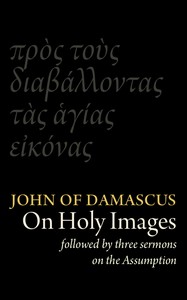
St John Damascene on Holy Images (πρὸς τοὺς διαβάλλοντας τᾶς ἁγίας εἰκόνας). Followed by Three Sermons on the Assumption (κοίμησις) — Edition Insights
(0 User reviews)
1623
Project Gutenberg
2015
Not confirmed
Mary, Blessed Virgin, Saint -- Assumption -- Sermons -- Early works to 1800; Idols and images -- Worship; Icons -- Cult
Readers of public-domain and historical texts
Project Gutenberg digital edition
en
Edition facts
Words
45,948
Reading time
200 min
Text sections
11
The source record for St John Damascene on Holy Images (πρὸς τοὺς διαβάλλοντας τᾶς ἁγίας εἰκόνας). Followed by Three Sermons on the Assumption (κοίμησις) — Edition Insights measures this digital text at 45,948 words, 3 hr 20 min estimated reading time, and 11 detected text sections.
The text analysis averages about 20.0 words per sentence, while the detected sections provide another way to judge how the source is divided.
Project Gutenberg metadata also associates the work with “Mary, Blessed Virgin, Saint -- Assumption -- Sermons -- Early works to 1800,” connecting these edition facts with the source record’s subject description.
Source:
Project Gutenberg record #49917
Mary H. Allies' 1898 translation of St John Damascene's defense of icons and three sermons on the Assumption, revealing how the eighth-century theologian argues for images as corporeal aids to worship, distinguishes latreia from douleia, and roots icon veneration in the Incarnation.
Read the complete public-domain text at its original source.
Read on Project GutenbergSt John Damascene's treatise on holy images, here translated by Mary H. Allies from the original Greek, opens with a striking parallel: the iconoclast controversy of the eighth century is directly compared to 'exciting scenes' in Anglican churches of the 1890s. Allies frames the work as a timely intervention, positioning the Damascene as a champion of the Communion of Saints against those who 'confuse the making of images with the making of idols.' The translator's preface makes clear that the treatise is not merely historical but polemical, aimed at contemporary English image-breakers whom she places 'in the camp of Leo the Isaurian.'
The Image as a Corporeal Necessity
Throughout the excerpts, John of Damascus repeatedly insists that human beings cannot reach God's throne 'without the help of corporeal things.' This is not a concession but a theological principle: the Incarnation has sanctified matter. He argues that as we must not make an image of the invisible God, so we must not refuse to look upon the Son, who is the 'Image by essence' and then became a visible image 'clothed in flesh and blood.' The logic is tightly woven: if God Himself took on a visible form, then visible representations of that form are not only permissible but fitting. The Damascene's diction here is precise, using the Greek term eikon to link the eternal image of the Father with the temporal image of the incarnate Son.
Distinguishing Worship: Latreia and Douleia
A central argument of the treatise is the careful distinction between types of worship. The seventh General Council, as noted in the preface, determined the different kinds using the Greek terms latreia and douleia. John applies this distinction rigorously: 'Let us worship and adore our God and Creator as alone worthy of worship by nature, and let us worship the holy Mother of God, not as God, but as God's Mother according to the flesh.' He extends the same logic to the saints, calling them 'the chosen friends of God' who 'reign over their passions.' The honour given to an image, he insists, 'is referred to the original,' citing Basil of Caesarea. This careful parsing of terms is not mere scholasticism; it is the backbone of his defense against the charge of idolatry.
The Testimony of Ancient Fathers
John does not rely solely on his own reasoning. The treatise includes a section titled 'Testimony of Ancient and Learned Fathers concerning Images,' where he marshals patristic authorities. He quotes Pseudo-Dionysius the Areopagite, who writes that 'sensible images do indeed show forth invisible things' and that we are 'led by the medium of sensible images to divine contemplation.' He also cites Basil of Caesarea's homily on the Forty Martyrs, where Basil notes that painters and orators alike 'have led many on to deeds of fortitude.' The Damascene's method is cumulative: he presents each father as a witness to an unbroken tradition, reinforcing his claim that icon veneration is not an innovation but a practice rooted in the earliest Christian centuries.
The Shadow and the Image
One of the most striking rhetorical moves in the excerpts is John's comparison of images to shadows. He asks: 'Their shadow alone has put forth disease and demons. Should we not deem a shadow a slighter and weaker thing than an image? Yet it is a true outline of the original.' Here he draws on the biblical account of Peter's shadow healing the sick (Acts 5:15), arguing that if a mere shadow can convey divine power, then an image—a deliberate representation—is even more fitting. This analogy reveals his characteristic method: he takes a familiar scriptural or patristic example and presses it into service for his argument, showing that the principle of representation is already embedded in Christian practice.
Readers approaching this text should attend to the interplay between theological argument and rhetorical strategy. John of Damascus writes as a controversialist, but one who grounds his case in Scripture, tradition, and the logic of the Incarnation. The translator's preface, with its pointed reference to contemporary Anglican controversies, reminds us that this is a work with a living edge. For those interested in the history of Christian art, the development of Mariology, or the theology of worship, this edition offers a primary source that rewards careful reading.
I found myself slowing down over the Damascene’s insistence that we honor what we see, because the invisible once became visible. It’s a strange comfort, that our clumsy gestures toward holiness aren’t wasted. It reminded me of an old habit I had with Bunyan — Reading Notes, where marginal scribbles felt like small prayers. We carry what we love in whatever form we can.
There are no reviews for this eBook.
There are no comments for this eBook.
Reader reflection
Your personal reading reflection
Build a private reading journal entry for this title.
Your progress
0
/
10
2
How did the book work for you overall?
3
Is this a title you would suggest to others?
4
How much effort did this book require?
5
How clear did the writing feel?
6
How original did the book feel?
7
How useful did the reading feel?
8
How personally connected did you feel to the book?
9
What changed or sharpened your thinking?
10