1

Biology versus Theology. The Bible: irreconcilable with Science, Experience, and even its own statements — Edition Insights
(0 User reviews)
1043
Project Gutenberg
2021
Not confirmed
Bible and science
Readers of public-domain and historical texts
Project Gutenberg digital edition
en
Edition facts
Words
27,763
Reading time
121 min
Text sections
3
This digital edition of Biology versus Theology. The Bible: irreconcilable with Science, Experience, and even its own statements — Edition Insights is described by source-level measurements including 27,763 words, 2 hr 1 min estimated reading time, and 3 detected text sections.
The text analysis averages about 20.2 words per sentence, while the detected sections provide another way to judge how the source is divided.
Project Gutenberg metadata also associates the work with “Bible and science,” connecting these edition facts with the source record’s subject description.
Source:
Project Gutenberg record #64500
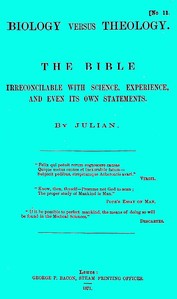
Julian's 1871 polemic argues the Bible contradicts science, experience, and itself, using close reading of Genesis, miracles, and biblical numbers. The opening invokes Huxley; later sections catalog temple vessel contradictions.
Read the complete public-domain text at its original source.
Read on Project GutenbergJulian opens with a quotation from Professor Huxley, who calls the Hebrew cosmogony 'the incubus of the philosopher and the opprobrium of the orthodox.' This sets the combative tone: the author aligns with 19th-century scientific rationalism and treats biblical narratives as historical claims to be tested. The table of contents reveals a three-part structure—Scripture versus science, human experience, and itself—with subsections on the Mosaic cosmogony, the Fall, the Flood, miracles, and contradictory texts. The excerpts show a methodical, evidence-based approach, citing specific verses and enumerating discrepancies.
Opening with Huxley and the Cosmogony
The introduction borrows Huxley’s authority, quoting his remark that 'the cosmogony of the semi-barbarous Hebrew is the incubus of the philosopher.' Julian extends this by listing the 'patient and earnest seekers after truth' whose lives were 'embittered by the mistaken zeal of bibliolaters.' The language is vivid: 'extinguished theologians lie about the cradle of every science, as the strangled snakes beside that of Hercules.' This metaphor frames the conflict as a battle where orthodoxy retreats 'bleeding and crushed.' The opening thus establishes a polemical stance, not a neutral inquiry, and signals that the book will treat biblical statements as factual claims to be refuted by science and reason.
The Temple Vessels: A Case Study in Contradiction
In the section on 'Misstatements,' Julian dissects the repeated spoliations of the temple vessels. He lists seven instances from Kings and Chronicles where kings 'took all the silver and gold' from the temple, yet later accounts still find vessels present. The tone is sardonic: 'These vessels seem to have possessed a wonderful recreative power. They were always being taken away to supply a temporary want of money, yet were always in the temple ready for a new spoliation.' Julian calculates that after Shishak, Asa, Jehoash, Ahaz, Hezekiah, and Nebuchadnezzar each removed 'all,' the vessels could not logically remain. He concludes that the numbers given by Ezra (5,400) are 'past understanding.' This passage exemplifies the book’s method: close reading of multiple verses to expose internal inconsistency.
The Name of God: A Textual Discrepancy
Julian examines Exodus 6:3, where God says he appeared to Abraham, Isaac, and Jacob as 'God Almighty' (El Shadday) but was not known to them by the name 'Jehovah.' The author points out that earlier Genesis passages use 'Jehovah' in dialogue with the patriarchs, creating a direct contradiction. This argument relies on textual evidence rather than scientific or experiential claims. It shows Julian’s willingness to treat the Bible as a historical document whose parts must be consistent. The excerpt breaks off before the full analysis, but the pattern is clear: Julian expects scripture to meet the same standards of coherence as any other text, and he finds it wanting.
Structure and Rhetorical Strategy
The book is organized into three main parts, each targeting a different ground of biblical authority: science, human experience, and internal consistency. Within each, Julian uses numbered lists and repeated citations to build cumulative cases. For example, the temple vessels section enumerates seven spoliations with precise references (1 Kings 14:25-26, 15:18, etc.). The rhetorical effect is forensic: the author presents evidence as a prosecutor would. The excerpts lack the conclusion, but the structure suggests a relentless accumulation of examples. Readers should note that Julian’s tone is often sarcastic, and his method relies on literal reading—he does not consider allegorical or theological interpretations. This makes the book a period piece of 19th-century rationalist critique.
Julian’s work is best read as a specimen of Victorian freethought polemic, not as a modern biblical criticism. Its value lies in its detailed catalog of discrepancies and its unapologetic use of science as a yardstick. Readers interested in the history of skepticism or the reception of Darwinism will find it revealing. Approach the text expecting a lawyerly brief rather than a scholarly dialogue; the author’s aim is to convict, not to converse.
I’ve often found myself shelving Julian’s stern little polemic beside a gentler confession, as if they were old acquaintances agreeing to disagree. The one dissects Scripture with cold patience; the other traces a believer’s slow unraveling. Both, in their way, honor the same ache for truth. Phases of Faith; Or, Passages from the History of My Creed — A Reader’s Guide sits nearby, its margins holding doubts I’ve come to respect.
There are no reviews for this eBook.
There are no comments for this eBook.
Reader reflection
Your personal reading reflection
Build a private reading journal entry for this title.
Your progress
0
/
10
2
Did this book hold your interest?
3
Would you encourage someone else to read it?
4
How easy was the book to follow?
5
Did the story or argument move comfortably?
6
Did you gain anything practical from the text?
7
How did the reading compare with what you expected?
8
Did any part of the book feel personally relevant?
9
What changed or sharpened your thinking?
10