1

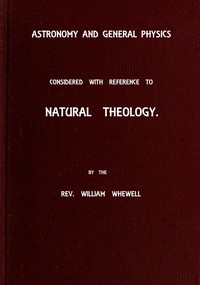
Astronomy and General Physics Considered with Reference to Natural Theology — Story, Setting & Ideas
(0 User reviews)
747
Project Gutenberg
2021
Not confirmed
Astronomy; Natural theology; Cosmic physics
Readers of public-domain and historical texts
Project Gutenberg digital edition
en
Edition facts
Words
96,163
Reading time
419 min
Text sections
56
The catalog record for Astronomy and General Physics Considered with Reference to Natural Theology — Story, Setting & Ideas provides practical reading context through 96,163 words, 6 hr 59 min estimated reading time, and 56 detected text sections.
The text analysis averages about 32.5 words per sentence, while the detected sections provide another way to judge how the source is divided.
Project Gutenberg metadata also associates the work with “Astronomy,” connecting these edition facts with the source record’s subject description.
Source:
Project Gutenberg record #66406
William Whewell's Bridgewater Treatise examines astronomical and physical phenomena as evidence of divine design, using Encke's comet and other celestial mechanics to argue for a purposeful cosmos.
Read the complete public-domain text at its original source.
Read on Project GutenbergWilliam Whewell's Astronomy and General Physics Considered with Reference to Natural Theology opens with a sustained argument that the laws of celestial motion themselves imply a designing intelligence. Rather than cataloging wonders, Whewell builds his case from the precise behavior of bodies like Encke's comet, whose extreme tenuity—appearing as a 'loose indefinitely formed speck of vapour'—reveals a resisting medium in space. This focus on subtle, measurable effects over grand spectacles marks the treatise's distinctive method: the very faintness of the evidence becomes its strongest proof.
The Comet as a Delicate Instrument
The discussion of Encke's comet exemplifies Whewell's method: he moves from a specific, well-documented phenomenon to a general principle. The comet's retardation, though 'extremely slight,' becomes a key witness for design because it shows that the cosmos is not a void but a plenum governed by consistent forces. Whewell's prose here is precise, almost clinical, yet the underlying argument is theological: the very subtlety of the effect underscores the wisdom required to embed such order in creation.
From Physics to Teleology
This section of the treatise is notable for its careful avoidance of overstatement. Whewell acknowledges that the evidence for design is often indirect, requiring 'reasonable arguments' rather than direct proof. He treats the reader as a fellow inquirer, inviting them to follow the logic step by step. The result is a work that feels more like a scientific lecture than a sermon, yet its ultimate aim is unmistakably theological.
Recurring Images of Order and Subtlety
Whewell also frequently contrasts the 'great and solid masses' of planets with the ethereal comet, using this opposition to highlight the range of divine creation. The same force that governs Jupiter also governs a wisp of vapour—a point that Whewell uses to argue for the unity of natural law. This structural repetition of contrasts and analogies gives the treatise a rhythmic quality, as each new example echoes and reinforces the previous ones.
Movement Between Scales
This technique of alternating scales gives the treatise its intellectual momentum. Whewell never stays long in the abstract; he continually grounds his claims in specific observations. Yet he also never loses sight of the larger theological framework. The result is a work that feels both rigorous and expansive, as if the reader is being led on a journey from the smallest detail to the grandest conclusion. The movement between scales is itself an argument for design: the same patterns recur at every level, suggesting a single intelligence behind them all.
Readers approaching Whewell's treatise should attend to its structure as much as its content. The work is not a simple catalogue of evidence but a carefully constructed argument that moves from the particular to the general, from the visible to the invisible. Pay attention to the recurring images and the shifts in scale; they are not decorative but essential to Whewell's case. The treatise rewards patient reading, revealing its full force only when its parts are seen as a whole.
Reading Whewell’s thoughts on Encke’s comet, I kept feeling how a vast order can feel both distant and deeply personal. That same quiet wonder stayed with me afterward, like an echo. It reminded me of the gentle, reasoned warmth in A Rational Theology, as Taught by the Church of Jesus Christ of Latter-Day Saints — Context and Discussion, where seeking understanding feels like coming home rather than solving a puzzle.
There are no reviews for this eBook.
There are no comments for this eBook.
Reader reflection
What did you think of this book?
Answer a few questions and save a private reflection on this device.
Your progress
0
/
10
2
How did the book work for you overall?
3
Would you recommend this book to another reader?
4
Did the language feel accessible?
5
Was the book easy to understand?
6
How strong was your personal connection to the text?
7
What did you appreciate most?
8
How useful did the reading feel?
9
What changed or sharpened your thinking?
10