1

A True Interpretation of the Witch of Endor — A Reader’s Guide
(0 User reviews)
554
Project Gutenberg
2022
Not confirmed
Witchcraft -- Early works to 1800; Soul -- Early works to 1800; Witch of Endor (Biblical figure); Bible. Samuel, 1st, XXVIII -- Criticism, interpretation, etc.
Readers of public-domain and historical texts
Project Gutenberg digital edition
en
Edition facts
Words
35,103
Reading time
153 min
Text sections
27
This digital edition of A True Interpretation of the Witch of Endor — A Reader’s Guide is described by source-level measurements including 35,103 words, 2 hr 33 min estimated reading time, and 27 detected text sections.
The text analysis averages about 49.8 words per sentence, while the detected sections provide another way to judge how the source is divided.
Project Gutenberg metadata also associates the work with “Witchcraft -- Early works to 1800,” connecting these edition facts with the source record’s subject description.
Source:
Project Gutenberg record #68704
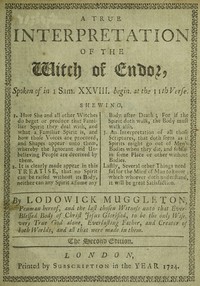
Lodowick Muggleton's 1724 treatise argues that the Witch of Endor raised Samuel's body, not a disembodied spirit, and that souls cannot exist without bodies. He reinterprets key Bible passages to refute the immortality of the soul, grounding his claims in a materialist theology that rejects reason in favor of revelation.
Read the complete public-domain text at its original source.
Read on Project GutenbergLodowick Muggleton's A True Interpretation of the Witch of Endor (1724) opens with a pointed claim: the familiar spirit of the witch did not raise a disembodied Samuel, but rather the prophet's entire body. Muggleton insists that 'no Spirit can be raised without its Body, neither can any Spirit assume any Body after Death.' This materialist reading of 1 Samuel 28 is the cornerstone of a broader argument against the immortality of the soul, a doctrine he attributes to 'the vain Imagination of Reason.' The treatise, self-published by Muggleton as 'the last chosen Witness unto that Ever-Blessed Body of Christ Jesus Glorified,' positions itself as a corrective to centuries of misinterpretation.
The Witch's Familiar as a Generated Spirit
Muggleton's interpretation hinges on the nature of the familiar spirit. He explains that witches 'do beget or produce that Familiar Spirit they deal with' through a process akin to generation, not by summoning the dead. The spirit is a created entity, not a wandering soul. This allows him to argue that the apparition of Samuel was a bodily resurrection, not a ghostly visitation. The text repeatedly stresses that 'the Soul or Life of the Child never went out of the Body' in the story of Elijah raising the widow's son, using that parallel to reinforce his point. For Muggleton, body and soul are inseparable; death is the death of both.
Solomon Dethroned: Reason vs. Revelation
A striking feature of the treatise is Muggleton's dismissal of Solomon's authority. He writes that Solomon's sayings 'are no Scripture, for Solomon was no Scripture Writer,' but wrote 'by the Revelation of Reason' rather than faith. This allows Muggleton to set aside Ecclesiastes 12:7—'the Spirit shall return to God who gave it'—as the product of natural wisdom, not divine truth. He accuses Solomon of ignorance about 'the Law of Generation or Procreation,' a charge that extends to 'the learned Philosophers' who claim a spirit cannot die. The argument is not merely theological but epistemological: only revelation, not reason, can correctly interpret Scripture.
A Treatise Against the Immortality of the Soul
The catalog subjects list 'Soul -- Early works to 1800' and 'Witchcraft,' but the excerpts show that Muggleton's primary target is the doctrine of the soul's survival after death. He declares that 'no Spirit doth go out of the Body when Men die, as is imagined by most People.' Instead, he insists that 'the Spirit or Soul of Man is generated and begotten by the Law of Generation as well as the Body.' This position leads him to reinterpret every scripture that 'doth seem as if Spirits might go out of Men's Bodies.' The treatise is thus less about witchcraft per se than about a materialist anthropology grounded in a literal reading of Genesis.
Readers should note that Muggleton's argument depends on a sharp distinction between reason and faith, and on a rejection of any spiritual substance separable from the body. His treatise is best approached as a specimen of radical Reformation thought, not as a conventional commentary on 1 Samuel. The excerpts suggest that the work's coherence rests on its consistent denial of disembodied spirits, a position that Muggleton defends by reclassifying certain biblical books as non-authoritative.
There’s something tender in Muggleton’s stubborn insistence that spirit needs flesh—that even Samuel couldn’t float free of his own bones. It makes me think of how we carry our old beliefs like worn garments. I found a kindred echo in Primitive culture, vol. 2 (of 2) — Inside the Classic, where survivals linger, half-remembered, still warm. Strange, how the past keeps breathing.
There are no reviews for this eBook.
There are no comments for this eBook.
Reader reflection
Your personal reading reflection
Build a private reading journal entry for this title.
Your progress
0
/
10
2
What was your overall reaction to the book?
3
Is this a title you would suggest to others?
4
What was the reading difficulty like?
5
Do you expect to return to this book?
6
How understandable was the text?
7
How much did the book move you?
8
Did the story or argument move comfortably?
9
In one sentence, what did you learn?
10